• Link to X
  • Link to Facebook
  • Link to Vimeo
  • Link to Mail
  • Español Español Spanish es
  • English English English en
Las políticas de la memoria
  • The Project
  • Research Team
    • Research team 2020-2024
    • Research Team 2016-2019
    • Research Team 2013-2015
    • Research Team 2010-2012
  • Team publications
    • Team books
    • Chapters and articles
  • Activities
    • Faces and traces of violence
    • Faces and traces of violence Lecture Series – Barcelona
    • Others activities
  • News
  • Mass media
  • Resources
    • Pedagogical resources
    • Links
  • Recommendations
    • Books
    • Audiovisuals
    • Articles, exhibitions and websites
  • Click to open the search input field Click to open the search input field Search
  • Menu Menu

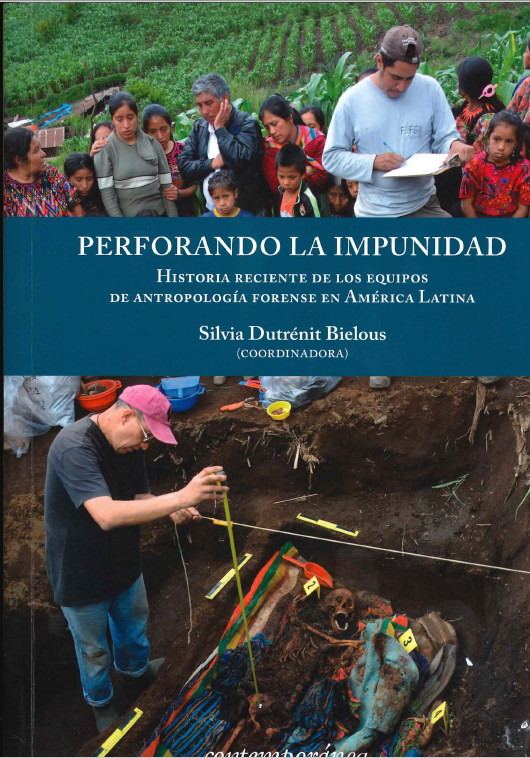
DUTRÉNIT, Silvia (coord.) (2018) Perforando la impunidad. Historia reciente de los equipos de antropología forense en América Latina.
June 7, 2018

The recent pasts were crossed by processes of repression and state violence over societies; they constitute a reference space for different generations and witnesses. This space is endowed by traumatic events that show socially filtered terror, with its inheritance of pain and crimes committed. While national experiences show a lot of distance from each other, they also illustrate the diversity of violent practices and conflicts. The common legacy is an accumulation of human rights violations that have an impact on social experiences. Since the mid 1980s, different types of transitions to democracy have begun in some countries. Respect for the rights of people in their relationship with public authorities began to be seen as an urgent issue, particularly in the face of the recurrent demand for truth and justice. Its development has been marked by marches and countermarches in terms of how to deal with the state of impunity inherited. On this past that is present, the forensic anthropology teams (EAF – in spanish) intervene and interact. They do so with a comprehensive humanistic social perspective, committed, at the same time with a scientific, methodological and instrumental way. The successful result of their work constitutes an excellent way of the historical narrative, at the same time that it has a restorative value for the victims and another legal value, for the compliance of the right to the truth. Who approaches and navigates in this book finds the evolution of these teams, their main characteristics, milestones and challenges in the experiences of Argentina, Chile, Guatemala, Mexico and Uruguay. Its content, focused on these emblematic actors of the framework of recent history, was in charge of Ana Buriano, Silvia Dutrénit, Claudia Rangel, Evangelina Sánchez, Octavio Nadal, Ricardo Sáenz, César Tcach and Isabel Torres, who are part of an interdisciplinary group of Latin American academics.

https://libreria.mora.edu.mx/?q=node/34684

Share this entry
  • Share on Facebook
  • Share on X
  • Share on WhatsApp
  • Share on LinkedIn
  • Share by Mail
https://politicasdelamemoria.org/wp-content/uploads/2018/06/Captura.png 758 530 F. https://politicasdelamemoria.org/wp-content/uploads/2015/01/logo_memoria_Web.png F.2018-06-07 16:36:032018-06-07 16:39:46DUTRÉNIT, Silvia (coord.) (2018) Perforando la impunidad. Historia reciente de los equipos de antropología forense en América Latina.

Lastest publications

  • DE KERANGAT, Zoé (2022). Memoria y justicia popular: Exhumaciones de las víctimas del franquismo durante la Transición españolaOctober 18, 2024 - 11:22 am
  • PALACIOS GONZÁLEZ, Daniel (2024). Making Monuments from Mass Graves in Contemporary SpainSeptember 17, 2024 - 5:15 pm
  • SAQQA CARAZO, Miriam (2024). Las exhumaciones por Dios y por EspañaSeptember 17, 2024 - 11:23 am

Lastest activities

  • Historical Memory and Archaeology of the Spanish Civil War and the Franco RegimeNovember 26, 2024 - 11:48 am
  • Where are the Africans? Erasure, elision and that task of self-writingSeptember 17, 2024 - 11:28 am
  • International Congress. Weaving memory: Public Policies, Mass Graves, and Materialities. 2024May 11, 2024 - 8:25 am
Tweets por el @PoliticaMemoria.

Políticas de la memoria

El pasado bajo tierra: exhumaciones y políticas de la memoria en la España contemporánea en perspectiva transnacional y comparada

Proyectos Asociados:
HISTOFOR: PID2024-159223NB-I00 (2026-20289
MEM2OR: BICON24084 (2025-2026)
NECROPOL: PID2019-104418RB-I00 (2020-2024)
SUBTIERRO: CSO2015-66104-R (2016-2019)
UNREST: H2020 REFLECTIVE-5-2015, ref. 693523 (2016-2019)
PASADO BAJO TIERRA: CSO2012-32709 (2013-2015)
ISTME: COST Action IS1203 (2012-2016)
POLMEM: CSO2009-09681 (2010-2013)
SPBUILD: 7PM MARIE CURIE, ITN 238589 (2010-2013)
PIE CSIC: 200710I006 (2007-2009). Las políticas de la memoria en la España contemporánea


Contact

Centro de Ciencias Humanas y Sociales - Consejo Superior de Investigaciones Científicas.
Offices: 1F25 and 1F18
Albasanz 26-28.
Madrid 28037 (Spain)
politicasdelamemoria@gmail.com

hosgeldin bonusu veren siteler

© Políticas de la memoria - 2015. Some rights reserved. Creative Commons license. | Web design and developmen by Freepress S. Coop. Mad.
  • Link to X
  • Link to Facebook
  • Link to Vimeo
  • Link to Mail
Link to: Con el Jesús en la boca: miedo, dominación y construcción de estado en la Colombia contemporánea Link to: Con el Jesús en la boca: miedo, dominación y construcción de estado en la Colombia contemporánea Con el Jesús en la boca: miedo, dominación y construcción de estado en la... Link to: 11/06/2018. Conference of Francisco Ferrándiz in Coria (Cáceres) Link to: 11/06/2018. Conference of Francisco Ferrándiz in Coria (Cáceres) 11/06/2018. Conference of Francisco Ferrándiz in Coria (Cáceres)
Scroll to top Scroll to top Scroll to top