• Link to X
  • Link to Facebook
  • Link to Vimeo
  • Link to Mail
  • Español Español Spanish es
  • English English English en
Las políticas de la memoria
  • The Project
  • Research Team
    • Research team 2020-2024
    • Research Team 2016-2019
    • Research Team 2013-2015
    • Research Team 2010-2012
  • Team publications
    • Team books
    • Chapters and articles
  • Activities
    • Faces and traces of violence
    • Faces and traces of violence Lecture Series – Barcelona
    • Others activities
  • News
  • Mass media
  • Resources
    • Pedagogical resources
    • Links
  • Recommendations
    • Books
    • Audiovisuals
    • Articles, exhibitions and websites
  • Click to open the search input field Click to open the search input field Search
  • Menu Menu

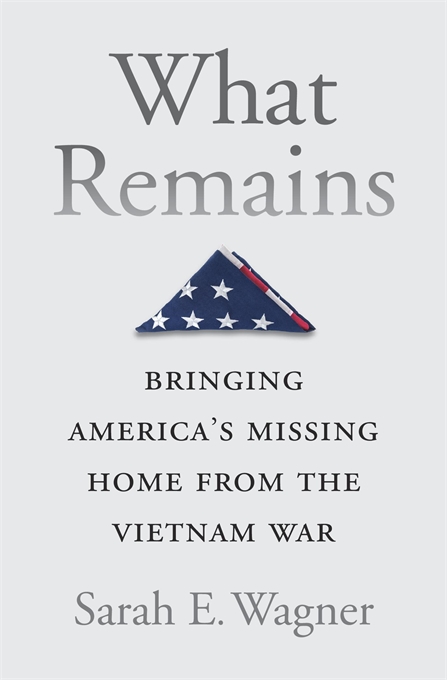
What Remains. Bringing America’s Missing Home from the Vietnam War
January 7, 2020

For many families the Vietnam War remains unsettled. Nearly 1,600 Americans—and more than 300,000 Vietnamese—involved in the conflict are still unaccounted for. In What Remains, Sarah E. Wagner tells the stories of America’s missing service members and the families and communities that continue to search for them. From the scientists who work to identify the dead using bits of bone unearthed in Vietnamese jungles to the relatives who press government officials to find the remains of their loved ones, Wagner introduces us to the men and women who seek to bring the missing back home. Through their experiences she examines the ongoing toll of America’s most fraught war.

Every generation has known the uncertainties of war. Collective memorials, such as the Tomb of the Unknowns in Arlington National Cemetery, testify to the many service members who never return, their fates still unresolved. But advances in forensic science have provided new and powerful tools to identify the remains of the missing, often from the merest trace—a tooth or other fragment. These new techniques have enabled military experts to recover, repatriate, identify, and return the remains of lost service members. So promising are these scientific developments that they have raised the expectations of military families hoping to locate their missing. As Wagner shows, the possibility of such homecomings compels Americans to wrestle anew with their memories, as with the weight of their loved ones’ sacrifices, and to reevaluate what it means to wage war and die on behalf of the nation.

Author: Sarah E. Wagner

For more information


Share this entry
  • Share on Facebook
  • Share on X
  • Share on WhatsApp
  • Share on LinkedIn
  • Share by Mail
https://politicasdelamemoria.org/wp-content/uploads/2020/01/libro_enero.jpg 680 447 F. https://politicasdelamemoria.org/wp-content/uploads/2015/01/logo_memoria_Web.png F.2020-01-07 16:06:432020-01-08 14:18:28What Remains. Bringing America’s Missing Home from the Vietnam War

Lastest publications

  • DE KERANGAT, Zoé (2022). Memoria y justicia popular: Exhumaciones de las víctimas del franquismo durante la Transición españolaOctober 18, 2024 - 11:22 am
  • PALACIOS GONZÁLEZ, Daniel (2024). Making Monuments from Mass Graves in Contemporary SpainSeptember 17, 2024 - 5:15 pm
  • SAQQA CARAZO, Miriam (2024). Las exhumaciones por Dios y por EspañaSeptember 17, 2024 - 11:23 am

Lastest activities

  • Historical Memory and Archaeology of the Spanish Civil War and the Franco RegimeNovember 26, 2024 - 11:48 am
  • Where are the Africans? Erasure, elision and that task of self-writingSeptember 17, 2024 - 11:28 am
  • International Congress. Weaving memory: Public Policies, Mass Graves, and Materialities. 2024May 11, 2024 - 8:25 am
Tweets por el @PoliticaMemoria.

Políticas de la memoria

El pasado bajo tierra: exhumaciones y políticas de la memoria en la España contemporánea en perspectiva transnacional y comparada

Proyectos Asociados:
HISTOFOR: PID2024-159223NB-I00 (2026-20289
MEM2OR: BICON24084 (2025-2026)
NECROPOL: PID2019-104418RB-I00 (2020-2024)
SUBTIERRO: CSO2015-66104-R (2016-2019)
UNREST: H2020 REFLECTIVE-5-2015, ref. 693523 (2016-2019)
PASADO BAJO TIERRA: CSO2012-32709 (2013-2015)
ISTME: COST Action IS1203 (2012-2016)
POLMEM: CSO2009-09681 (2010-2013)
SPBUILD: 7PM MARIE CURIE, ITN 238589 (2010-2013)
PIE CSIC: 200710I006 (2007-2009). Las políticas de la memoria en la España contemporánea


Contact

Centro de Ciencias Humanas y Sociales - Consejo Superior de Investigaciones Científicas.
Offices: 1F25 and 1F18
Albasanz 26-28.
Madrid 28037 (Spain)
politicasdelamemoria@gmail.com

hosgeldin bonusu veren siteler

© Políticas de la memoria - 2015. Some rights reserved. Creative Commons license. | Web design and developmen by Freepress S. Coop. Mad.
  • Link to X
  • Link to Facebook
  • Link to Vimeo
  • Link to Mail
Link to: Around Episodios de una Guerra Interminable by Almudena Grandes Link to: Around Episodios de una Guerra Interminable by Almudena Grandes Around Episodios de una Guerra Interminable by Almudena Grandes Link to: FERRÁNDIZ, Francisco and GARCÍA, María (2019). Demanda Pedro Fausto Canales Bermejo contra España. Informe pericial sobre víctimas del franquismo en la sociedad española contemporánea (15 de septiembre de 2012) Link to: FERRÁNDIZ, Francisco and GARCÍA, María (2019). Demanda Pedro Fausto Canales Bermejo contra España. Informe pericial sobre víctimas del franquismo en la sociedad española contemporánea (15 de septiembre de 2012) FERRÁNDIZ, Francisco and GARCÍA, María (2019). Demanda Pedro Fausto Canales...
Scroll to top Scroll to top Scroll to top