• Link to X
  • Link to Facebook
  • Link to Vimeo
  • Link to Mail
  • Español Español Spanish es
  • English English English en
Las políticas de la memoria
  • The Project
  • Research Team
    • Research team 2020-2024
    • Research Team 2016-2019
    • Research Team 2013-2015
    • Research Team 2010-2012
  • Team publications
    • Team books
    • Chapters and articles
  • Activities
    • Faces and traces of violence
    • Faces and traces of violence Lecture Series – Barcelona
    • Others activities
  • News
  • Mass media
  • Resources
    • Pedagogical resources
    • Links
  • Recommendations
    • Books
    • Audiovisuals
    • Articles, exhibitions and websites
  • Click to open the search input field Click to open the search input field Search
  • Menu Menu

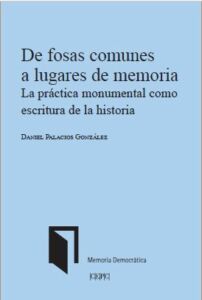
PALACIOS GONZÁLEZ, Daniel (2022). De fosas comunes a lugares de memoria. La práctica monumental como escritura de la historia
November 24, 2022

De fosas comunes a lugares de memoria

La práctica monumental como escritura de la historia

Within this book, I focused on the meaningful gestures of producing images using the bodies buried in the mass graves of the Spanish War and Dictatorship from 1936 until nowadays. The objective I proposed for this research was to define the historical development of monument practices and the forms they had taken, understand them in the society they seek to influence, and try to attribute a sense to them as meaningful gestures. I draw up my cartography of monuments in the country, with 600 records. But, far from seeking unity based on generalisations, I tried to find the logic underlying each of the experiences. To do so, I decided to take a broad sample and leave the quantitative study to approach the practices qualitatively. Accordingly, I selected a large selection of 100, which consisted of visiting the sites and interviewing those involved in these practices.
Additionally, in many of those sites visited, I also developed observation and participant observation in different rituals and events. I organised the book into three parts, each covering a stage of the analysis. In the first part, I answered the question of how the production of monuments evolved and what forms they took. In the second part, I answer the question of how monument practices were incorporated into the society they sought to influence. In the third part, I point out how we are not dealing with simple reactions that respond to the formal logic of tradition, but, on the contrary, they look for a specific and reasonable end goal, a result based on planning and consciousness.
In conclusion, I proved how the monument becomes an expression of the historical consciousness of its producers. How different actors communicated their memories in a meaningful gesture limited by the material reality integrating the bodies in constructing a new image. And how they seek to influence society, not just bury the dead according to a funerary tradition.

 More information


Share this entry
  • Share on Facebook
  • Share on X
  • Share on WhatsApp
  • Share on LinkedIn
  • Share by Mail
https://politicasdelamemoria.org/wp-content/uploads/2022/10/captura0.jpg 407 274 Miriam Saqqa https://politicasdelamemoria.org/wp-content/uploads/2015/01/logo_memoria_Web.png Miriam Saqqa2022-11-24 11:43:222022-11-24 11:43:22PALACIOS GONZÁLEZ, Daniel (2022). De fosas comunes a lugares de memoria. La práctica monumental como escritura de la historia

Lastest publications

  • DE KERANGAT, Zoé (2022). Memoria y justicia popular: Exhumaciones de las víctimas del franquismo durante la Transición españolaOctober 18, 2024 - 11:22 am
  • PALACIOS GONZÁLEZ, Daniel (2024). Making Monuments from Mass Graves in Contemporary SpainSeptember 17, 2024 - 5:15 pm
  • SAQQA CARAZO, Miriam (2024). Las exhumaciones por Dios y por EspañaSeptember 17, 2024 - 11:23 am

Lastest activities

  • Historical Memory and Archaeology of the Spanish Civil War and the Franco RegimeNovember 26, 2024 - 11:48 am
  • Where are the Africans? Erasure, elision and that task of self-writingSeptember 17, 2024 - 11:28 am
  • International Congress. Weaving memory: Public Policies, Mass Graves, and Materialities. 2024May 11, 2024 - 8:25 am
Tweets por el @PoliticaMemoria.

Políticas de la memoria

El pasado bajo tierra: exhumaciones y políticas de la memoria en la España contemporánea en perspectiva transnacional y comparada

Proyectos Asociados:
HISTOFOR: PID2024-159223NB-I00 (2026-20289
MEM2OR: BICON24084 (2025-2026)
NECROPOL: PID2019-104418RB-I00 (2020-2024)
SUBTIERRO: CSO2015-66104-R (2016-2019)
UNREST: H2020 REFLECTIVE-5-2015, ref. 693523 (2016-2019)
PASADO BAJO TIERRA: CSO2012-32709 (2013-2015)
ISTME: COST Action IS1203 (2012-2016)
POLMEM: CSO2009-09681 (2010-2013)
SPBUILD: 7PM MARIE CURIE, ITN 238589 (2010-2013)
PIE CSIC: 200710I006 (2007-2009). Las políticas de la memoria en la España contemporánea


Contact

Centro de Ciencias Humanas y Sociales - Consejo Superior de Investigaciones Científicas.
Offices: 1F25 and 1F18
Albasanz 26-28.
Madrid 28037 (Spain)
politicasdelamemoria@gmail.com

hosgeldin bonusu veren siteler

© Políticas de la memoria - 2015. Some rights reserved. Creative Commons license. | Web design and developmen by Freepress S. Coop. Mad.
  • Link to X
  • Link to Facebook
  • Link to Vimeo
  • Link to Mail
Link to: FERRÁNDIZ, Francisco (2022). Exhumaciones, generales y militarismo fantasma: cómo confrontar el legado de la Guerra Civil española Link to: FERRÁNDIZ, Francisco (2022). Exhumaciones, generales y militarismo fantasma: cómo confrontar el legado de la Guerra Civil española FERRÁNDIZ, Francisco (2022). Exhumaciones, generales y militarismo fantasma:... Link to: La muerte en los ojos: qué perpetran las imágenes de perpetrador (Alianza, 2021) Reflexiones en torno al libro de Vicente Sánchez-Biosca Link to: La muerte en los ojos: qué perpetran las imágenes de perpetrador (Alianza, 2021) Reflexiones en torno al libro de Vicente Sánchez-Biosca La muerte en los ojos: qué perpetran las imágenes de perpetrador (Alianza,...
Scroll to top Scroll to top Scroll to top