• Link to X
  • Link to Facebook
  • Link to Vimeo
  • Link to Mail
  • Español Español Español es
  • English English Inglés en
Las políticas de la memoria en España
  • Proyecto
  • Equipo
    • Equipo 2025-2027
    • Equipo 2020-2024
    • Equipo 2016-2019
    • Equipo 2013-2015
    • Equipo 2010-2012
  • Publicaciones
    • Libros del equipo
    • Capítulos y artículos
  • Actividades
    • Seminario Rastros y Rostros de la Violencia
    • Seminari Rastres i Rostres de la Violència
    • Otras actividades
  • Actualidad
  • Prensa
  • Recursos
    • Materiales
    • Enlaces
  • Recomendaciones
    • Libros recomendados
    • Audiovisuales de interés
    • Artículos, exposiciones y webs
  • Digital.CSIC
  • Click to open the search input field Click to open the search input field Buscar
  • Menú Menú

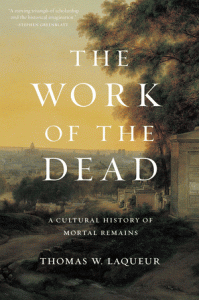
LIQUEUR, Thomas W. (2015) The Work of the Dead: A Cultural History of Mortal Remains
julio 12, 2016

The Greek philosopher Diogenes said that when he died his body should be tossed over the city walls for beasts to scavenge. Why should he or anyone else care what became of his corpse? In The Work of the Dead, acclaimed cultural historian Thomas Laqueur examines why humanity has universally rejected Diogenes’s argument. No culture has been indifferent to mortal remains. Even in our supposedly disenchanted scientific age, the dead body still matters—for individuals, communities, and nations. A remarkably ambitious history, The Work of the Dead offers a compelling and richly detailed account of how and why the living have cared for the dead, from antiquity to the twentieth century.

The book draws on a vast range of sources—from mortuary archaeology, medical tracts, letters, songs, poems, and novels to painting and landscapes in order to recover the work that the dead do for the living: making human communities that connect the past and the future. Laqueur shows how the churchyard became the dominant resting place of the dead during the Middle Ages and why the cemetery largely supplanted it during the modern period. He traces how and why since the nineteenth century we have come to gather the names of the dead on great lists and memorials and why being buried without a name has become so disturbing. And finally, he tells how modern cremation, begun as a fantasy of stripping death of its history, ultimately failed—and how even the ashes of the victims of the Holocaust have been preserved in culture.

A fascinating chronicle of how we shape the dead and are in turn shaped by them, this is a landmark work of cultural history.


Thomas W. Laqueur is the Helen Fawcett Professor of History at the University of California, Berkeley. His books includeMaking Sex: Body and Gender from the Greeks to Freud and Solitary Sex: A Cultural History of Masturbation. He is a regular contributor to the London Review of Books.

Editado por Princeton University Press


PREMIOS:

One of The Guardian’s Best Books of 2015, selected by Alison Light
One of Flavorwire’s 10 Best Books by Academic Publishers in 2015
One of Flavorwire’s 15 Best Nonfiction Books of 2015


Disponible para su lectura: Introduction The Work of the Dead

Indice del libro

Compartir esta entrada
  • Compartir en Facebook
  • Compartir en X
  • Compartir en WhatsApp
  • Compartir en LinkedIn
  • Compartir por correo
https://politicasdelamemoria.org/wp-content/uploads/2016/04/k10535.gif 453 300 Laura Langa https://politicasdelamemoria.org/wp-content/uploads/2015/01/logo_memoria_Web.png Laura Langa2016-07-12 12:33:452016-08-18 14:11:36LIQUEUR, Thomas W. (2015) The Work of the Dead: A Cultural History of Mortal Remains

Últimas publicaciones

  • SAQQA CARAZO, Miriam (2026). Fosas de republicanos en Madrid: localizaciones e investigaciones en base a la Causa General.mayo 18, 2026 - 3:25 pm
  • Díaz-Ramoneda, Eulàlia y Queralt Solé Barjau (edt.) (2026). Mujeres exhumadas. Guerra y posguerra: la violencia contra las mujeres por parte del bando sublevado.mayo 13, 2026 - 9:35 am
  • SAQQA CARAZO, Miriam y RENSHAW, Layla (2026). Martyr Materiality in Exhumations under the Spanish Dictatorship: Deconstructing the Francoist Narrative in the 1939 Soto de Aldovea Casemarzo 17, 2026 - 12:09 pm

Últimas actividades

  • Conferencia «OBJETOS CULPABLES. Memoria familiar y cultura material»mayo 20, 2026 - 5:15 pm
  • Conferencia «Posturas estéticas frente a la violencia. Cinco textos sobre la Guerra Civil»abril 8, 2026 - 12:43 pm
  • Conferencia «Cerca de aquí»marzo 8, 2026 - 12:39 pm
Tweets por el @PoliticaMemoria.

Políticas de la memoria

El pasado bajo tierra: exhumaciones y políticas de la memoria en la España contemporánea en perspectiva transnacional y comparada

Proyectos Asociados:
HISTOFOR: PID2024-159223NB-I00 (2026-20289
MEM2OR: BICON24084 (2025-2026)
NECROPOL: PID2019-104418RB-I00 (2020-2024)
SUBTIERRO: CSO2015-66104-R (2016-2019)
UNREST: H2020 REFLECTIVE-5-2015, ref. 693523 (2016-2019)
PASADO BAJO TIERRA: CSO2012-32709 (2013-2015)
ISTME: COST Action IS1203 (2012-2016)
POLMEM: CSO2009-09681 (2010-2013)
SPBUILD: 7PM MARIE CURIE, ITN 238589 (2010-2013)
PIE CSIC: 200710I006 (2007-2009). Las políticas de la memoria en la España contemporánea


Contacto

Centro de Ciencias Humanas y Sociales - Consejo Superior de Investigaciones Científicas.
Despachos 1F25 y 1F18
C/Albasanz 26-28.
Madrid 28037 (España)
politicasdelamemoria@gmail.com

hosgeldin bonusu veren siteler

© Políticas de la memoria- 2015. Algunos derechos reservados. Licencia Creative Commons. | Desarrollo y diseño web: Freepress S. Coop. Mad.
  • Link to X
  • Link to Facebook
  • Link to Vimeo
  • Link to Mail
Link to: «Lo que permanece» – una reseña del documental de Lee Douglas Link to: «Lo que permanece» – una reseña del documental de Lee Douglas «Lo que permanece» – una reseña del documental de Lee Douglas Link to: Francisco Ferrándiz y Francisco Etxeberría. rt.com. 29/07/2016. España, la memoria enterrada Link to: Francisco Ferrándiz y Francisco Etxeberría. rt.com. 29/07/2016. España, la memoria enterrada Francisco Ferrándiz y Francisco Etxeberría. rt.com. 29/07/2016. España, la...
Desplazarse hacia arriba Desplazarse hacia arriba Desplazarse hacia arriba