• Link to X
  • Link to Facebook
  • Link to Vimeo
  • Link to Mail
  • Español Español Spanish es
  • English English English en
Las políticas de la memoria
  • The Project
  • Research Team
    • Research team 2020-2024
    • Research Team 2016-2019
    • Research Team 2013-2015
    • Research Team 2010-2012
  • Team publications
    • Team books
    • Chapters and articles
  • Activities
    • Faces and traces of violence
    • Faces and traces of violence Lecture Series – Barcelona
    • Others activities
  • News
  • Mass media
  • Resources
    • Pedagogical resources
    • Links
  • Recommendations
    • Books
    • Audiovisuals
    • Articles, exhibitions and websites
  • Click to open the search input field Click to open the search input field Search
  • Menu Menu

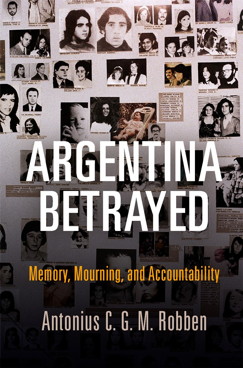
Argentina Betrayed. Memory, Mourning, and Accountability
February 13, 2020

The ruthless military dictatorship that ruled Argentina between 1976 and 1983 betrayed the country’s people, presiding over massive disappearances of its citizenry and, in the process, destroying the state’s trustworthiness as the guardian of safety and well-being. Desperate relatives risked their lives to find the disappeared, and one group of mothers defied the repressive regime with weekly protests at the Plaza de Mayo in Buenos Aires. How do societies cope with human losses and sociocultural traumas in the aftermath of such instances of political violence and state terror?

In Argentina Betrayed, Antonius C. G. M. Robben demonstrates that the dynamics of trust and betrayal that convulsed Argentina during the dictatorship did not end when democracy returned but rather persisted in confrontations over issues such as the truth about the disappearances, the commemoration of the past, and the guilt and accountability of perpetrators. Successive governments failed to resolve these debates because of erratic policies made under pressure from both military and human rights groups. Mutual mistrust between the state, retired officers, former insurgents, and bereaved relatives has been fueled by recurrent revelations and controversies that prevent Argentine society from conclusively coming to terms with its traumatic past.

With thirty years of scholarly engagement with Argentina—and drawing on his extensive, fair-minded interviews with principals at all points along the political spectrum—Robben explores how these ongoing dynamics have influenced the complicated mourning over violent deaths and disappearances. His analysis deploys key concepts from the contemporary literature of human rights, transitional justice, peace and reconciliation, and memory studies, including notions of trauma, denial, accountability, and mourning. The resulting volume is an indispensable contribution to a better understanding of the terrible crimes committed by the Argentine dictatorship in the 1970s and their aftermath.

Author: Antonius C. G. M. Robben

For more information


Share this entry
  • Share on Facebook
  • Share on X
  • Share on WhatsApp
  • Share on LinkedIn
  • Share by Mail
https://politicasdelamemoria.org/wp-content/uploads/2020/02/libro_robben.jpg 368 243 F. https://politicasdelamemoria.org/wp-content/uploads/2015/01/logo_memoria_Web.png F.2020-02-13 16:05:382020-03-04 16:18:20Argentina Betrayed. Memory, Mourning, and Accountability

Lastest publications

  • DE KERANGAT, Zoé (2022). Memoria y justicia popular: Exhumaciones de las víctimas del franquismo durante la Transición españolaOctober 18, 2024 - 11:22 am
  • PALACIOS GONZÁLEZ, Daniel (2024). Making Monuments from Mass Graves in Contemporary SpainSeptember 17, 2024 - 5:15 pm
  • SAQQA CARAZO, Miriam (2024). Las exhumaciones por Dios y por EspañaSeptember 17, 2024 - 11:23 am

Lastest activities

  • Historical Memory and Archaeology of the Spanish Civil War and the Franco RegimeNovember 26, 2024 - 11:48 am
  • Where are the Africans? Erasure, elision and that task of self-writingSeptember 17, 2024 - 11:28 am
  • International Congress. Weaving memory: Public Policies, Mass Graves, and Materialities. 2024May 11, 2024 - 8:25 am
Tweets por el @PoliticaMemoria.

Políticas de la memoria

El pasado bajo tierra: exhumaciones y políticas de la memoria en la España contemporánea en perspectiva transnacional y comparada

Proyectos Asociados:
HISTOFOR: PID2024-159223NB-I00 (2026-20289
MEM2OR: BICON24084 (2025-2026)
NECROPOL: PID2019-104418RB-I00 (2020-2024)
SUBTIERRO: CSO2015-66104-R (2016-2019)
UNREST: H2020 REFLECTIVE-5-2015, ref. 693523 (2016-2019)
PASADO BAJO TIERRA: CSO2012-32709 (2013-2015)
ISTME: COST Action IS1203 (2012-2016)
POLMEM: CSO2009-09681 (2010-2013)
SPBUILD: 7PM MARIE CURIE, ITN 238589 (2010-2013)
PIE CSIC: 200710I006 (2007-2009). Las políticas de la memoria en la España contemporánea


Contact

Centro de Ciencias Humanas y Sociales - Consejo Superior de Investigaciones Científicas.
Offices: 1F25 and 1F18
Albasanz 26-28.
Madrid 28037 (Spain)
politicasdelamemoria@gmail.com

hosgeldin bonusu veren siteler

© Políticas de la memoria - 2015. Some rights reserved. Creative Commons license. | Web design and developmen by Freepress S. Coop. Mad.
  • Link to X
  • Link to Facebook
  • Link to Vimeo
  • Link to Mail
Link to: Removing heaven and earth. The exhumations of victims of Francoism as fissures of silence in the transition Link to: Removing heaven and earth. The exhumations of victims of Francoism as fissures of silence in the transition Removing heaven and earth. The exhumations of victims of Francoism as fissures... Link to: HRISTOVA, Marije (2020). La lucha por la memoria histórica en España: más allá de la genealogía y las generaciones Link to: HRISTOVA, Marije (2020). La lucha por la memoria histórica en España: más allá de la genealogía y las generaciones HRISTOVA, Marije (2020). La lucha por la memoria histórica en España: más...
Scroll to top Scroll to top Scroll to top