• Link to X
  • Link to Facebook
  • Link to Vimeo
  • Link to Mail
  • Español Español Español es
  • English English Inglés en
Las políticas de la memoria en España
  • Proyecto
  • Equipo
    • Equipo 2025-2027
    • Equipo 2020-2024
    • Equipo 2016-2019
    • Equipo 2013-2015
    • Equipo 2010-2012
  • Publicaciones
    • Libros del equipo
    • Capítulos y artículos
  • Actividades
    • Seminario Rastros y Rostros de la Violencia
    • Seminari Rastres i Rostres de la Violència
    • Otras actividades
  • Actualidad
  • Prensa
  • Recursos
    • Materiales
    • Enlaces
  • Recomendaciones
    • Libros recomendados
    • Audiovisuales de interés
    • Artículos, exposiciones y webs
  • Digital.CSIC
  • Click to open the search input field Click to open the search input field Buscar
  • Menú Menú

Heonik Kwon

mayo 31, 2010

Heonik Kwon is a Senior Research Fellow in Social Science and Professor of Social Anthropology, Trinity College, University of Cambridge.

Born in Seoul, I spent most of my childhood in Daegu in close vicinity to one of the US Eighth Army bases existing in South Korea, Camp Henry. Later I lived and worked in the United States, former Soviet Russia and Vietnam. Within our project team, I am happy to work with an expanding group of eminent and likeminded international scholars from diverse disciplinary and personal backgrounds, but also to be part of a same-age group, together with four other project members, who were all born in the lunar Year of the Tiger, 1962. Some of us in this group take it as something akin to a question of destiny that we have ended up under the same roof of Korean War studies (this war, in fact, broke out in the previous Tiger Year, 1950) and with a shared hope to go beyond the enduring legacy of this painfully formative event of the early Cold War. Whereas my researches are primarily about memories of war in intimate domains, I am keen to learn from innovative studies in international and world history. I am interested in the very concept of the Cold War and in Cold War history as an intellectual question. However, I also take great interest in opening up new horizons of empirical research such as the environmental history of the Cold War and post-Cold War in regional and global contexts.

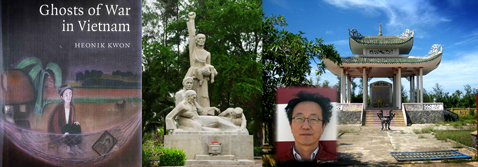
I am trained as an anthropologist, having done fieldwork in a small nomadic community in indigenous Siberia and in villages of central Vietnam before I joined the Korean War studies.  I am currently Senior Research Fellow in Social Science and Distinguished Research Professor of Social Anthropology at Trinity College, University of Cambridge, and previously taught anthropology at the London School of Economics. I served as an external advisor to the Army of the Republic of Korea for its forensic anthropological taskforce as well as to South Korea’s Truth and Reconciliation Commission. My work in Vietnam resulted in After the Massacre (2006, Geertz prize), and Ghosts of War in Vietnam (2008, Kahin prize). I also wrote The Other Cold War (2010) and have a new co-authored book published in 2012, North Korea Beyond Charismatic Politics. I am completing a book on Korea’s civil war experience seen in the context of family genealogical histories. Another book-length study in preparation explores how North Korea tells its war experiences.
Curriculum vitae
Web personal
Compartir esta entrada
  • Compartir en Facebook
  • Compartir en X
  • Compartir en WhatsApp
  • Compartir en LinkedIn
  • Compartir por correo
https://politicasdelamemoria.org/wp-content/uploads/2010/05/Heonik-Kwon_copy_web.jpg 167 478 Daniel https://politicasdelamemoria.org/wp-content/uploads/2015/01/logo_memoria_Web.png Daniel2010-05-31 11:12:082018-05-16 20:04:33Heonik Kwon

Últimas publicaciones

  • SAQQA CARAZO, Miriam (2026). Fosas de republicanos en Madrid: localizaciones e investigaciones en base a la Causa General.mayo 18, 2026 - 3:25 pm
  • Díaz-Ramoneda, Eulàlia y Queralt Solé Barjau (edt.) (2026). Mujeres exhumadas. Guerra y posguerra: la violencia contra las mujeres por parte del bando sublevado.mayo 13, 2026 - 9:35 am
  • SAQQA CARAZO, Miriam y RENSHAW, Layla (2026). Martyr Materiality in Exhumations under the Spanish Dictatorship: Deconstructing the Francoist Narrative in the 1939 Soto de Aldovea Casemarzo 17, 2026 - 12:09 pm

Últimas actividades

  • Conferencia «OBJETOS CULPABLES. Memoria familiar y cultura material»mayo 20, 2026 - 5:15 pm
  • Conferencia «Posturas estéticas frente a la violencia. Cinco textos sobre la Guerra Civil»abril 8, 2026 - 12:43 pm
  • Conferencia «Cerca de aquí»marzo 8, 2026 - 12:39 pm
Tweets por el @PoliticaMemoria.

Políticas de la memoria

El pasado bajo tierra: exhumaciones y políticas de la memoria en la España contemporánea en perspectiva transnacional y comparada

Proyectos Asociados:
HISTOFOR: PID2024-159223NB-I00 (2026-20289
MEM2OR: BICON24084 (2025-2026)
NECROPOL: PID2019-104418RB-I00 (2020-2024)
SUBTIERRO: CSO2015-66104-R (2016-2019)
UNREST: H2020 REFLECTIVE-5-2015, ref. 693523 (2016-2019)
PASADO BAJO TIERRA: CSO2012-32709 (2013-2015)
ISTME: COST Action IS1203 (2012-2016)
POLMEM: CSO2009-09681 (2010-2013)
SPBUILD: 7PM MARIE CURIE, ITN 238589 (2010-2013)
PIE CSIC: 200710I006 (2007-2009). Las políticas de la memoria en la España contemporánea


Contacto

Centro de Ciencias Humanas y Sociales - Consejo Superior de Investigaciones Científicas.
Despachos 1F25 y 1F18
C/Albasanz 26-28.
Madrid 28037 (España)
politicasdelamemoria@gmail.com

hosgeldin bonusu veren siteler

© Políticas de la memoria- 2015. Algunos derechos reservados. Licencia Creative Commons. | Desarrollo y diseño web: Freepress S. Coop. Mad.
  • Link to X
  • Link to Facebook
  • Link to Vimeo
  • Link to Mail
Link to: Ariel Jerez Link to: Ariel Jerez Ariel Jerez Link to: José Manuel Pureza Link to: José Manuel Pureza José Manuel Pureza
Desplazarse hacia arriba Desplazarse hacia arriba Desplazarse hacia arriba