• Link to X
  • Link to Facebook
  • Link to Vimeo
  • Link to Mail
  • Español Español Spanish es
  • English English English en
Las políticas de la memoria
  • The Project
  • Research Team
    • Research team 2020-2024
    • Research Team 2016-2019
    • Research Team 2013-2015
    • Research Team 2010-2012
  • Team publications
    • Team books
    • Chapters and articles
  • Activities
    • Faces and traces of violence
    • Faces and traces of violence Lecture Series – Barcelona
    • Others activities
  • News
  • Mass media
  • Resources
    • Pedagogical resources
    • Links
  • Recommendations
    • Books
    • Audiovisuals
    • Articles, exhibitions and websites
  • Click to open the search input field Click to open the search input field Search
  • Menu Menu

Heonik Kwon

May 31, 2010

Born in Seoul, I spent most of my childhood in Daegu in close vicinity to one of the US Eighth Army bases existing in South Korea, Camp Henry. Later I lived and worked in the United States, former Soviet Russia and Vietnam. Within our project team, I am happy to work with an expanding group of eminent and likeminded international scholars from diverse disciplinary and personal backgrounds, but also to be part of a same-age group, together with four other project members, who were all born in the lunar Year of the Tiger, 1962. Some of us in this group take it as something akin to a question of destiny that we have ended up under the same roof of Korean War studies (this war, in fact, broke out in the previous Tiger Year, 1950) and with a shared hope to go beyond the enduring legacy of this painfully formative event of the early Cold War. Whereas my researches are primarily about memories of war in intimate domains, I am keen to learn from innovative studies in international and world history. I am interested in the very concept of the Cold War and in Cold War history as an intellectual question. However, I also take great interest in opening up new horizons of empirical research such as the environmental history of the Cold War and post-Cold War in regional and global contexts.

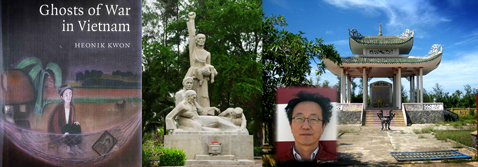
I am trained as an anthropologist, having done fieldwork in a small nomadic community in indigenous Siberia and in villages of central Vietnam before I joined the Korean War studies.  I am currently Senior Research Fellow in Social Science and Distinguished Research Professor of Social Anthropology at Trinity College, University of Cambridge, and previously taught anthropology at the London School of Economics. I served as an external advisor to the Army of the Republic of Korea for its forensic anthropological taskforce as well as to South Korea’s Truth and Reconciliation Commission. My work in Vietnam resulted in After the Massacre (2006, Geertz prize), and Ghosts of War in Vietnam (2008, Kahin prize). I also wrote The Other Cold War (2010) and have a new co-authored book published in 2012, North Korea Beyond Charismatic Politics. I am completing a book on Korea’s civil war experience seen in the context of family genealogical histories. Another book-length study in preparation explores how North Korea tells its war experiences.
Curriculum vitae
Web personal
Share this entry
  • Share on Facebook
  • Share on X
  • Share on WhatsApp
  • Share on LinkedIn
  • Share by Mail
https://politicasdelamemoria.org/wp-content/uploads/2010/05/Heonik-Kwon_copy_web.jpg 167 478 Daniel https://politicasdelamemoria.org/wp-content/uploads/2015/01/logo_memoria_Web.png Daniel2010-05-31 11:12:082018-05-16 20:04:35Heonik Kwon

Lastest publications

  • DE KERANGAT, Zoé (2022). Memoria y justicia popular: Exhumaciones de las víctimas del franquismo durante la Transición españolaOctober 18, 2024 - 11:22 am
  • PALACIOS GONZÁLEZ, Daniel (2024). Making Monuments from Mass Graves in Contemporary SpainSeptember 17, 2024 - 5:15 pm
  • SAQQA CARAZO, Miriam (2024). Las exhumaciones por Dios y por EspañaSeptember 17, 2024 - 11:23 am

Lastest activities

  • Historical Memory and Archaeology of the Spanish Civil War and the Franco RegimeNovember 26, 2024 - 11:48 am
  • Where are the Africans? Erasure, elision and that task of self-writingSeptember 17, 2024 - 11:28 am
  • International Congress. Weaving memory: Public Policies, Mass Graves, and Materialities. 2024May 11, 2024 - 8:25 am
Tweets por el @PoliticaMemoria.

Políticas de la memoria

El pasado bajo tierra: exhumaciones y políticas de la memoria en la España contemporánea en perspectiva transnacional y comparada

Proyectos Asociados:
HISTOFOR: PID2024-159223NB-I00 (2026-20289
MEM2OR: BICON24084 (2025-2026)
NECROPOL: PID2019-104418RB-I00 (2020-2024)
SUBTIERRO: CSO2015-66104-R (2016-2019)
UNREST: H2020 REFLECTIVE-5-2015, ref. 693523 (2016-2019)
PASADO BAJO TIERRA: CSO2012-32709 (2013-2015)
ISTME: COST Action IS1203 (2012-2016)
POLMEM: CSO2009-09681 (2010-2013)
SPBUILD: 7PM MARIE CURIE, ITN 238589 (2010-2013)
PIE CSIC: 200710I006 (2007-2009). Las políticas de la memoria en la España contemporánea


Contact

Centro de Ciencias Humanas y Sociales - Consejo Superior de Investigaciones Científicas.
Offices: 1F25 and 1F18
Albasanz 26-28.
Madrid 28037 (Spain)
politicasdelamemoria@gmail.com

hosgeldin bonusu veren siteler

© Políticas de la memoria - 2015. Some rights reserved. Creative Commons license. | Web design and developmen by Freepress S. Coop. Mad.
  • Link to X
  • Link to Facebook
  • Link to Vimeo
  • Link to Mail
Link to: Ariel Jerez Link to: Ariel Jerez Ariel Jerez Link to: José Manuel Pureza Link to: José Manuel Pureza José Manuel Pureza
Scroll to top Scroll to top Scroll to top